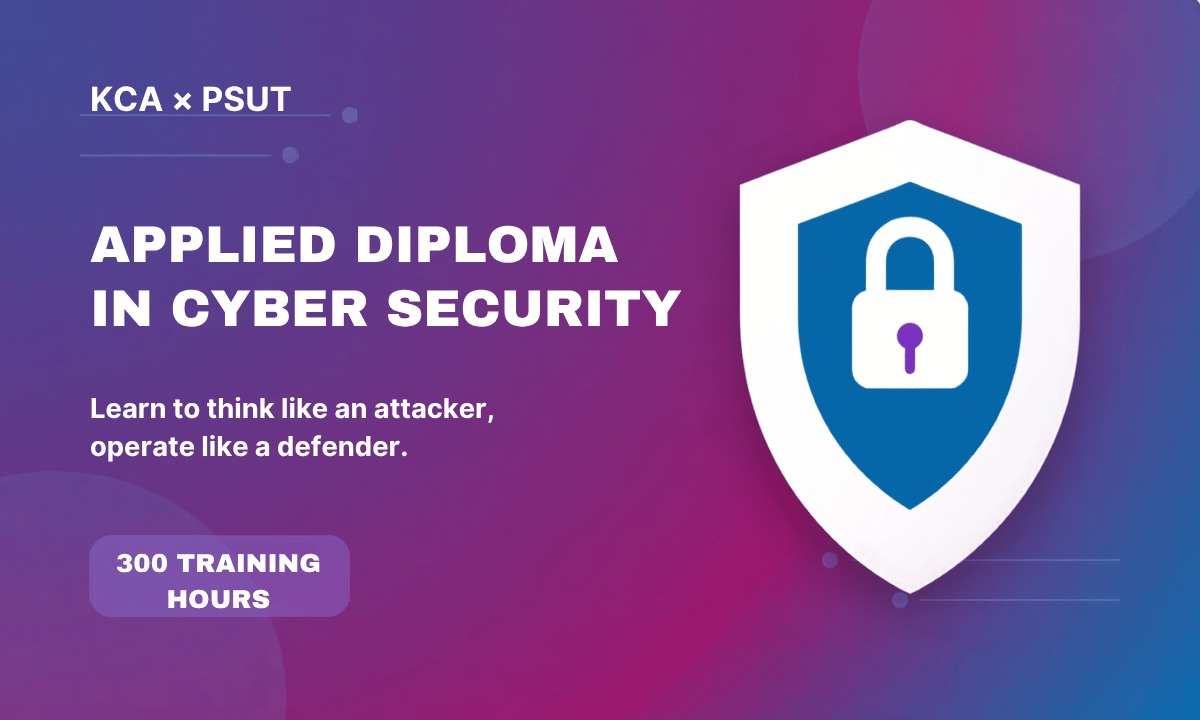
Applied Diploma

Applied Diploma in Cyber Security

A 300-hour applied learning journey designed to build practical, job-relevant capabilities across modern cybersecurity.

Applied Diploma in Cyber Security
Partnership / Provider Knowledge Circle Academy × PSUT
Learning Duration 300 Training Hours
Discover the Program

Program Overview

The Applied Diploma in Cyber Security is a comprehensive, practice-oriented program delivered in collaboration between Knowledge Circle Academy and Princess Sumaya University for Technology (PSUT). Across 500 training hours, participants progress from essential English, IT, networking, and programming foundations to advanced offensive security, SOC operations, critical-infrastructure protection, governance, risk and compliance, threat intelligence, and incident response.

The diploma combines structured teaching with practical activities, projects, hands-on exercises, case studies, and realistic scenarios. Participants learn how cyber threats develop, how security teams identify and investigate them, how controlled security testing is conducted, and how organizations build resilient security programs.

Program Details

Why Choose This Diploma?

01 A broad, structured pathway that begins with core IT and communication foundations and progresses to advanced cybersecurity practice.
02 Hands-on learning through labs, activities, projects, realistic scenarios, and security case studies.
03 Balanced exposure to defensive and offensive cybersecurity disciplines.
04 Practical use of widely adopted tools and frameworks, including SIEM platforms, Kali Linux, Nmap, Metasploit, Burp Suite, Wireshark, NIST guidance, MITRE ATT&CK, ISO 27001, and threat-intelligence standards.
05 Professional development in technical English, reporting, security documentation, teamwork, and stakeholder communication.
06 Career-relevant coverage of SOC operations, penetration testing, incident response, threat intelligence, GRC, network security, and critical-infrastructure protection.
Program Details

What You Will Be Able to Do

01 Understand computer systems, operating systems, networking models, protocols, and common security controls.
02 Use Python to automate security tasks, analyze logs and data, interact with networks and APIs, and support security-testing workflows.
03 Identify vulnerabilities and perform controlled ethical-hacking and penetration-testing activities.
04 Monitor security events, analyze logs, triage alerts, and contribute to SOC investigations.
05 Apply threat intelligence and structured incident-response methods to detect, contain, eradicate, and recover from cyber incidents.
06 Assess risks, interpret security frameworks, support compliance activities, and contribute to cybersecurity policies and governance.
07 Evaluate risks affecting critical infrastructure and recommend controls that improve resilience.
08 Document technical findings and present clear, actionable security recommendations.
Program Details

Who Is This Program For?

01 Aspiring cybersecurity professionals seeking a structured entry into the field.
02 University students and graduates in cybersecurity, IT, computer science, engineering, or related disciplines.
03 IT, networking, and technical-support professionals who want to transition into security roles.
04 Early-career security professionals who want broader applied exposure across offensive, defensive, and governance domains.
05 Individuals interested in SOC operations, ethical hacking, penetration testing, incident response, threat intelligence, or GRC.
Program Details

Career Pathways

01 SOC Analyst or Security Monitoring Analyst
02 Junior Cybersecurity Analyst
03 Junior Penetration Tester or Vulnerability Assessment Analyst
04 Network Security or Critical-Infrastructure Security Support Analyst
05 Incident Response or Digital Forensics Support Analyst
06 Threat Intelligence Analyst
07 GRC or Information Security Compliance Analyst
Learning Journey

Curriculum

1
Stage 1

CS101 · English Skills and IT Fundamentals | 50 hours (30 teaching + 20 activities)

Technical English, cybersecurity terminology, professional communication, computer hardware and software, operating systems, networking basics, troubleshooting, and foundational security principles.

2
Stage 2

CS201 · Information System Security | 45 hours (24 teaching + 21 projects)

Security principles, threats, access control, cryptography, network protection, risk management, governance, compliance, incident response, security assessments, and system hardening.

3
Stage 3

CS202 · Programming with Python | 45 hours (24 teaching + 21 projects)

Python fundamentals and applied scripting for security automation, packet analysis, cryptography, log analysis, digital forensics, vulnerability assessment, web interactions, APIs, and secure coding.

4
Stage 4

CS203 · Networking and Data Security Fundamentals | 45 hours (24 teaching + 21 projects)

OSI and TCP/IP models, network architectures, devices and protocols, common threats, firewalls, access control, encryption, authentication, monitoring, intrusion detection, and secure data transmission.

5
Stage 5

CS204 · Ethical Hacking and Testing | 45 hours (24 teaching + 21 projects)

Ethical-hacking methodologies, OSINT, scanning and enumeration, vulnerability assessment, web and network testing, exploitation, privilege escalation, wireless security, reporting, and legal and ethical practice.

6
Stage 6

CS205 · Security Operations Center Analyst | 45 hours (24 teaching + 21 projects)

SOC workflows, SIEM and log analysis, alert triage, threat detection, security monitoring, threat intelligence, incident handling, forensics, NIST practices, and MITRE ATT&CK.

7
Stage 7

CS301 · Advanced Hacking Techniques | 45 hours (24 teaching + 21 projects)

Advanced testing, post-exploitation, evasion, privilege escalation, lateral movement, persistence, exploit-development concepts, cloud and IoT weaknesses, APT simulations, and defensive countermeasures.

8
Stage 8

CS302 · Conducting Penetration and Security Tests | 45 hours (24 teaching + 21 projects)

Structured penetration-testing engagements covering reconnaissance, scanning, exploitation, privilege escalation, assessment of security controls, mitigation planning, and professional reporting.

9
Stage 9

CS303 · Operational Security for Critical Infrastructure | 45 hours (24 teaching + 21 projects)

Threats to critical systems, security controls, resilience, network segmentation, identity and access management, monitoring, incident response, secure communications, compliance, and risk mitigation.

10
Stage 10

CS304 · Cybersecurity Management (GRC) | 45 hours (24 teaching + 21 projects)

Governance, risk and compliance; policies and procedures; risk assessment; ISO 27001, NIST CSF and GDPR; internal audit; continuous monitoring; incident response; and business continuity.

11
Stage 11

CS305 · Threat Intelligence and Incident Response | 45 hours (24 teaching + 21 projects)

Threat-data collection and analysis, OSINT, threat feeds, MITRE ATT&CK, STIX/TAXII, threat-intelligence programs, common attacks, incident-response phases, case studies, and stakeholder coordination.

Applicant Details

Fields marked with an asterisk are required.

GDPR

When you visit any of our websites, it may store or retrieve information on your browser, mostly in the form of cookies. This information might be about you, your preferences or your device and is mostly used to make the site work as you expect it to. The information does not usually directly identify you, but it can give you a more personalized web experience. Because we respect your right to privacy, you can choose not to allow some types of cookies. Click on the different category headings to find out more and manage your preferences. Please note, that blocking some types of cookies may impact your experience of the site and the services we are able to offer.